
How to Check Criminal History in Kimble County
Kimble County has no single database that joins every incident, booking, prosecution, and sentence. Begin with the County/District Clerk when the goal is a filed felony or misdemeanor case. The clerk links iDocket, the Tyler UCMS Public Portal, and re:SearchTX. A current custody question belongs with the Kimble County Sheriff and jail. DPS supplies statewide public conviction and deferred-adjudication data, while a fingerprint review is the stronger path for examining one’s own Texas repository record.
Gather the full name, date of birth, spelling variants, approximate event date, and any report, booking, warrant, or cause number. Then work from the narrow local record toward broader state systems. A court result identifies the filed charge and disposition. A jail source addresses custody. Neither replaces the other.
- Search the Kimble County clerk links for a cause number, party name, court, and filing date.
- Check both District Court felony matters and County Court misdemeanor matters. Fine-only cases may remain with the Justice Court or Junction Municipal Court.
- Call the Sheriff/Jail for a recent booking or current custody question, then use VINELink for available status and notifications.
- Use DPS for public statewide conviction or deferred-adjudication data, and use FAST fingerprint review for your own fuller record.
- Request a certified disposition from the clerk when an official court outcome or a DPS correction requires it.
Three Kimble County Court Record Portals
The clerk offers three search paths because their coverage and document access can differ. iDocket supports county and name or case-number routes. Tyler UCMS uses a county or location choice, search type, party or business name, case number, dates, and court filters. re:SearchTX adds a statewide court search layer, though document visibility remains subject to clerk permissions and user role.
The re:SearchTX court search shows the statewide entry screen used for Kimble County criminal case research.
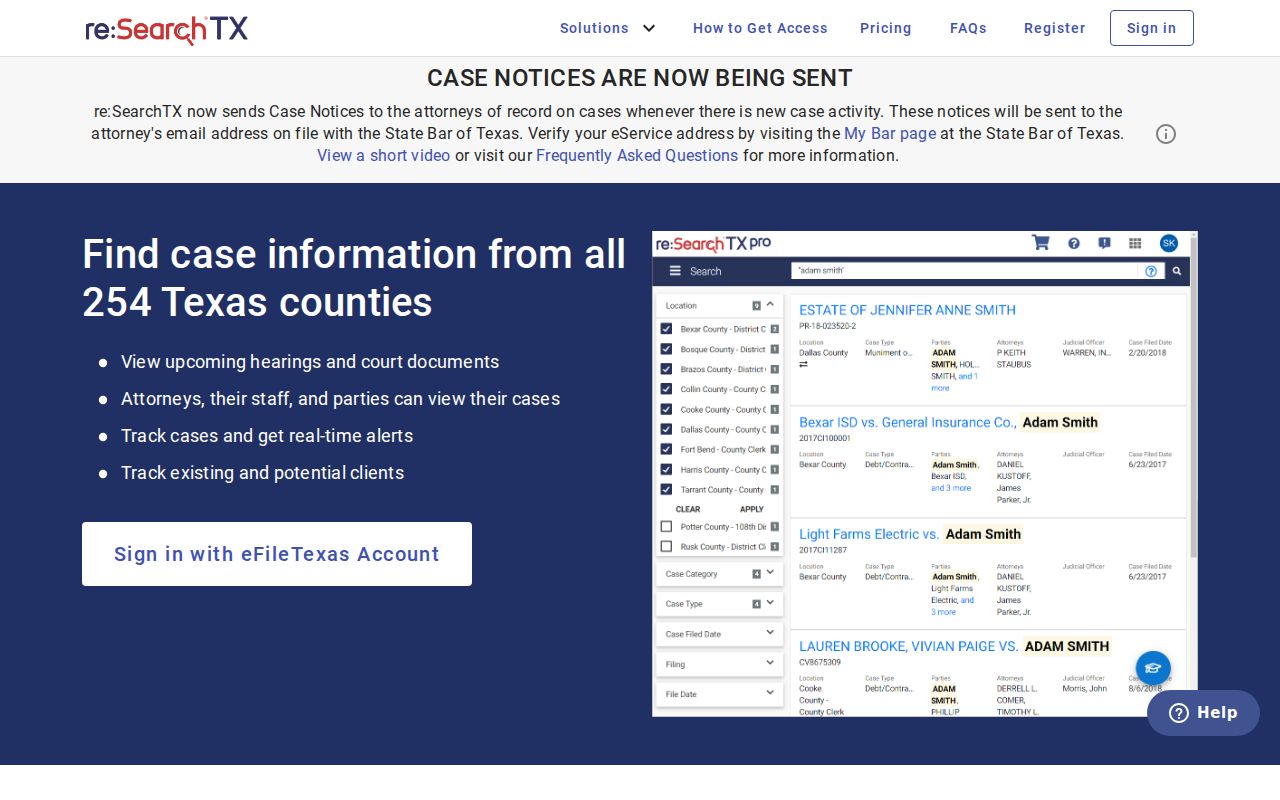
Use the court, party, date, and case-type controls together when a common name produces too many possible Kimble County records.
The Kimble County District Clerk page is the official launch point for all three approved court-search links.
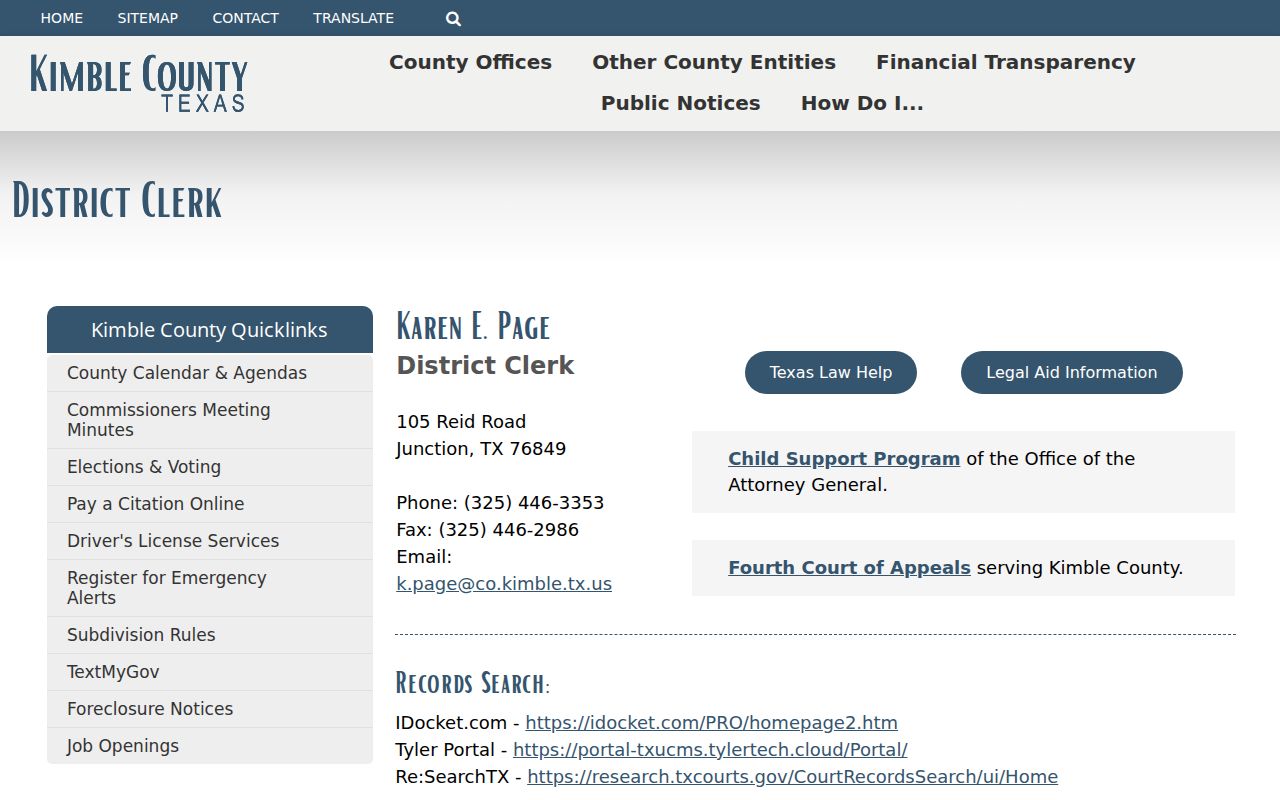
Starting there helps avoid an unrelated commercial service and gives the current clerk contact when an online search falls short.
| Channel | Useful fields | Best use |
|---|---|---|
| iDocket | County, party name, case number | Local case entry route |
| Tyler UCMS | Location, search type, case, party, date | Filtered public portal search |
| re:SearchTX | Court, party, attorney, case number, dates | Statewide court layer |
Official Texas Background Checks
The Texas Department of Public Safety Crime Records Division maintains the Computerized Criminal History system. Its public name product shows qualifying Texas convictions and deferred adjudications reported to DPS. Online searches use prepaid credits. One credit costs $1, a card purchase adds 2.25 percent per credit and a $0.25 transaction fee, and a search consumes a credit even when no match appears. Opening more possible matches can use more credits. Form CR-42 offers the same public product by mail for $10 per search.
The DPS Criminal History Search requires an account and prepaid credits before a Kimble County name query can be run.
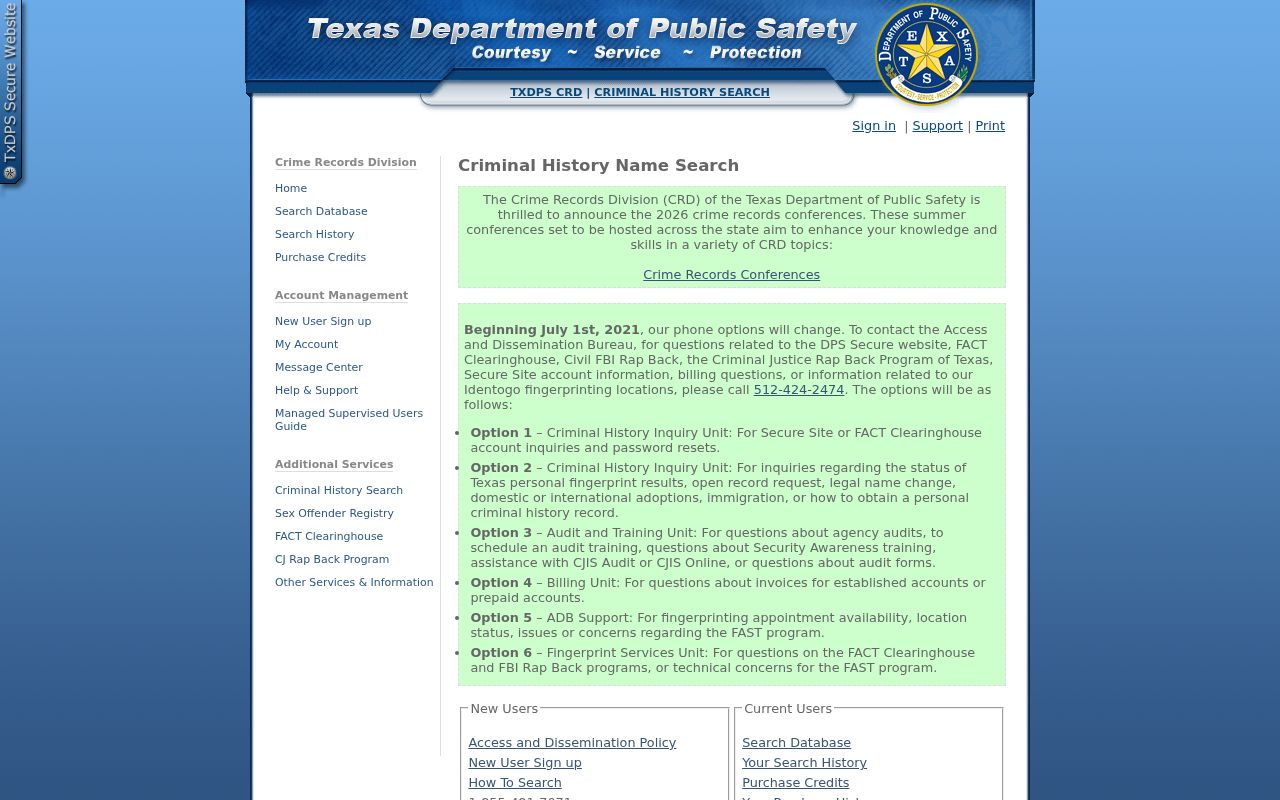
That public name search is useful for statewide public data, but it is not a complete local case file or a positive identity match.
For personal review, DPS uses FAST through IdentoGO by IDEMIA. DPS lists $15 for the Texas fingerprint record review and $10 for FAST fingerprinting. No permanent enrollment site inside Kimble County was verified, so the official locator may route a resident to a traveling or out-of-county location.
The IdentoGO enrollment scheduler is the correct place to find a current fingerprint appointment rather than relying on an assumed Junction site.
The live scheduler confirms the actual site, date, and vendor total before travel.
Kimble County Record Match Pitfalls
DPS name matching can use exact or Soundex logic. Soundex returns names that sound alike, which helps with spelling variants but raises the risk of choosing the wrong person. Add the first and middle names, date of birth, sex, and race when known. Compare every returned identifier. DPS warns that only fingerprints reliably connect a person to a criminal history record.
A no-match result also needs care. It may mean the identifiers did not align, an agency has not submitted the event, or the public product cannot display it. A local dismissal may remain in a booking file even when no conviction appears. Conversely, a clerk case can reveal a disposition missing from DPS due to reporting lag. For your own disputed record, get a certified disposition from the court of jurisdiction and use the DPS error-resolution route.
| Product | Scope | Captured fee |
|---|---|---|
| DPS online name search | Public convictions and deferred adjudications | $1 credit plus card charges |
| CR-42 mail search | Public data by submitted identifiers | $10 per search |
| DPS personal review | Your fingerprint-associated Texas history | $15 DPS plus $10 FAST |
Types of Criminal Records
A Kimble County criminal record can refer to several files made at different stages. The arresting agency writes the incident or arrest narrative. The jail creates an intake and booking entry. A prosecutor may then file a complaint, information, or seek a felony indictment. The clerk maintains the court case, while DPS receives reportable arrest and disposition events.
Matching the question to the right custodian prevents a common search failure. These five groups cover the main routes:
- Arrest and booking records: The Sheriff, Junction Police, DPS, or another arresting agency holds its report, while the jail holds intake and custody data.
- Criminal court files: The County/District Clerk keeps cause numbers, filed charges, docket events, judgments, and sentences.
- State criminal history: DPS compiles reportable cycles, but its public name product is narrower than a fingerprint personal review.
- Warrants and capias: The issuing court and law enforcement track them; Kimble County has no official public active-warrant database.
- Custody and supervision: The county jail, TDCJ, Adult Probation, and the state parole system hold distinct records.
Registry entries form another public record class. The Texas Public Sex Offender Registry has its own law, search controls, and excluded fields.
Kimble County Clerk Record Counter
Courthouse restoration changed where Kimble County criminal records are reached. The historic courthouse remains at 501 Main Street, yet the combined County/District Clerk and Adult Probation offices moved to 105 Reid Road. The clerk’s line is (325) 446-3353. Hearings can use several designated sites, so a legal court address shown in a directory may not be the current counter or courtroom.
The Kimble County government home page presents the courthouse and routes readers to current county offices.

The image marks the historic civic center, but the current criminal-record request still needs the restoration-era office location confirmed before travel.
The Kimble County contact directory assigns county and district criminal cases to the combined clerk.
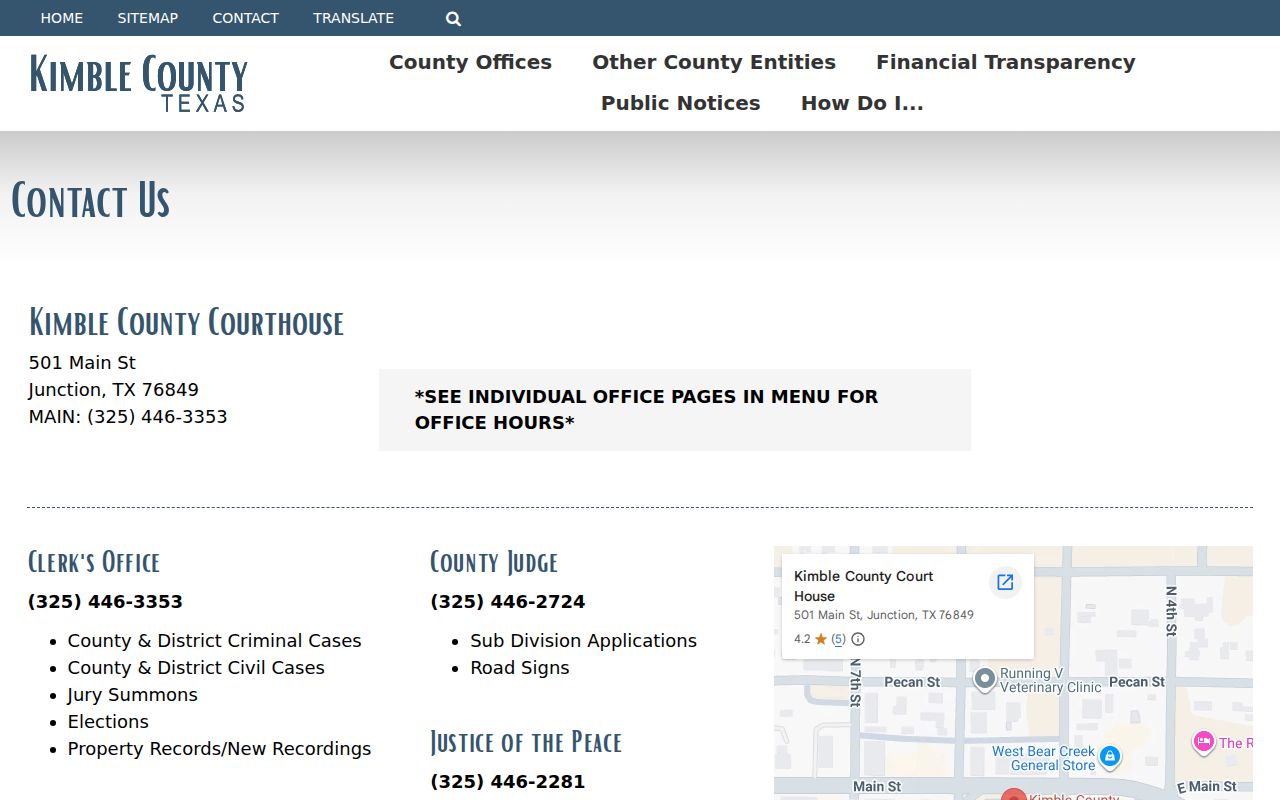
That routing distinction keeps court pleadings with the clerk and incident reports with the agency that created them.
County/District Clerk
105 Reid Road
Junction, TX 76849
(325) 446-3353
Sheriff and Jail
415 Pecan Street
Junction, TX 76849
(325) 446-2766
Justice Court
415 Main Street
Junction, TX 76849
(325) 446-2281
What a Kimble County Criminal Record Shows
The fields depend on which Kimble County record is open. A Texas CCH cycle emphasizes identity, arrest, prosecution, court outcome, sentence, custody, and supervision data reported by participating agencies. A clerk file focuses on the cause number and what happened in court. A jail entry focuses on intake, booked allegations, bond, and release or custody state.
| Name & Identifiers | Names, aliases, birth date, descriptive data, and agency or state identifiers where public. |
|---|---|
| Arrest / Booking Data | Arresting agency, event and intake dates, tracking number, booked allegations, bond, and custody state. |
| Charges & Statutes | Alleged offense at arrest and the charge later filed by the prosecutor, which may differ. |
| Disposition | Dismissal, acquittal, conviction, deferred adjudication, or another current court outcome. |
| Sentence | Confinement, fine, costs, restitution, or community-supervision terms shown by the judgment. |
| Custody / Supervision | County jail, TDCJ, probation, or parole status within the limits of each source. |
Read the source label before drawing a conclusion. An arrest is an allegation, and a court disposition is the better record of the final case result.
Kimble County Criminal Record Flow
A local event can produce several records in sequence: Incident or Arrest Report → Jail Booking → Prosecutor Review → Court Filing → Judgment and Disposition → DPS Reporting. Each handoff can change what is shown. The officer’s booked charge may be reduced, enhanced, replaced, or rejected. A case may be dismissed while the booking remains in the sheriff’s files.
Class B misdemeanors and more serious arrest events are reportable to DPS with fingerprints. Chapter 66 reporting later sends qualifying prosecution and disposition data to the repository. The county court portals can show a new case before the statewide cycle is complete. For a full outcome, compare the booking event with the filed Kimble County criminal case and its certified disposition.
- Cause number
- The clerk’s identifier for a filed court case.
- Disposition
- The current or final outcome of a charge.
- Deferred adjudication
- Community supervision without an initial judgment of guilt, subject to Texas law and later consequences.
- Capias
- A court writ directing that a person be taken into custody.
Public Access Laws
Texas law makes access record-specific. The Texas Public Information Act applies to public information held by governmental bodies unless an exception permits withholding. Court records also operate under judicial access rules and clerk controls. DPS criminal history is confidential except where Chapter 411 authorizes a public product. Registry data has a separate statutory disclosure scheme.
Key Texas laws:
Government Code §552.021 grants access to governmental public information unless an exception applies.
Government Code §411.135 authorizes DPS to release public conviction and deferred-adjudication history.
Code of Criminal Procedure Chapter 55A governs expunction of qualifying arrest and case records.
Code of Criminal Procedure art. 62.005 defines public registry data and fields that remain excluded.
Juvenile data, victim identities, active-investigation details, personal identifiers, sealed files, expunged material, and nondisclosure-protected history may be withheld or redacted. A right to ask does not guarantee release of every field.
Unscanned Kimble County Criminal Records
A blank portal result does not prove that no Kimble County criminal case exists. The clerk documented older books, off-site microfilm, fragile volumes, and back-scanning done as funds and time allow. Some material must be found by staff or reviewed in a supervised reading area. Record books cannot be taken apart for copying without clerk help, and the clerk bars food, drink, and flash photography near them.
The Kimble County Clerk records page gives the current office route for court material that cannot be resolved online.
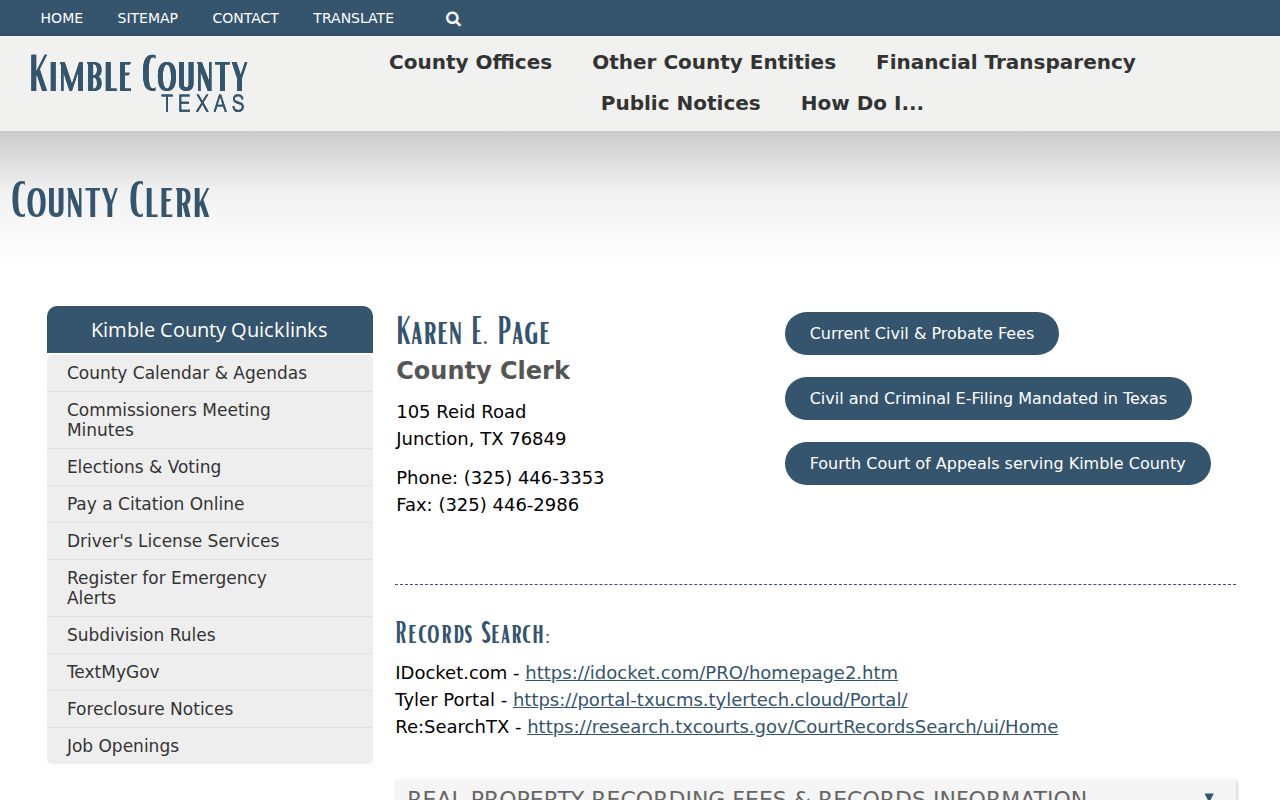
Provide a name, approximate year, court, charge, and cause number if known so staff can narrow the book or microfilm search.
Copies cost $1 per page, and certification is $5 per document under the located clerk schedule. A certified disposition is especially useful when correcting a DPS cycle. Call first because restoration can affect the counter and retrieval time.
Sealed, Expunged & Restricted
Texas expunction and nondisclosure do different work. An expunction under Chapter 55A can require qualifying records to be destroyed or returned and can permit denial of the event, subject to statutory limits. Eligibility can arise from an acquittal, pardon, certain dismissals after timing rules, a no-bill, identity theft, or other listed circumstances. A conviction does not usually qualify just because time has passed.
An order of nondisclosure restricts public dissemination of qualifying criminal history but does not destroy the record. Criminal justice agencies and other authorized recipients can retain access. Juvenile records and victim-sensitive or sealed material follow their own restrictions. In Kimble County, filing and local form questions go to the County/District Clerk at 105 Reid Road. No county-specific petition packet or expunction filing fee was found in the official research, so request a current quote.
Keep certified copies of any order. Then verify the clerk portals and DPS separately. Synchronization can take time, and a docket stub may remain while documents become unavailable.
Kimble County Jail Record Search
Kimble County does not publish a verified county-hosted jail roster, booking log, warrant search, or sheriff app. For present custody, call the Sheriff/Jail at 415 Pecan Street. The official sheriff page links VINELink for available custody status and notifications. A written request to the sheriff can seek a booking entry or arrest report that is not routinely displayed.
The Kimble County Sheriff page gives the local jail contact and the official VINELink route.
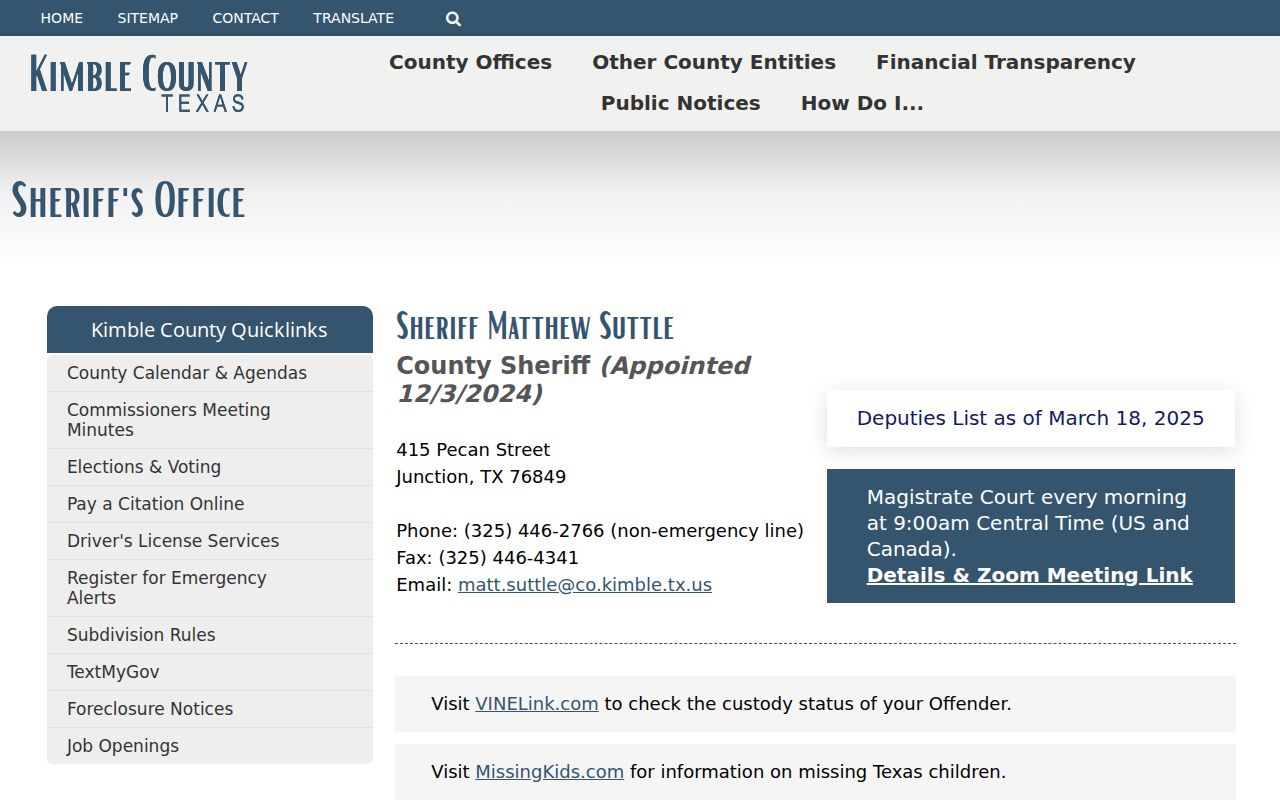
It also posts a daily 9:00 a.m. Central magistrate-court notice, which reflects the early warning and bond stage after arrest.
In February 2025, the official monthly report listed 10 arrests and 20 jail bookings. Those are workload counts for one month, not convictions, a crime rate, or a count of unique county residents. The difference also shows why arrest and booking totals cannot be treated as the same measure.
Kimble County Custody Record Layers
Custody searches change with the institution. The county jail answers local pretrial and short-term questions. VINELink may provide status and change notices. TDCJ Online Inmate Search applies after a person enters the state prison system, and the federal Bureau of Prisons locator covers federal imprisonment. None proves what final charge a Kimble County court filed.
The TDCJ Online Inmate Search accepts a last and first name, a seven-digit TDCJ number, or a SID number, with gender and race filters.
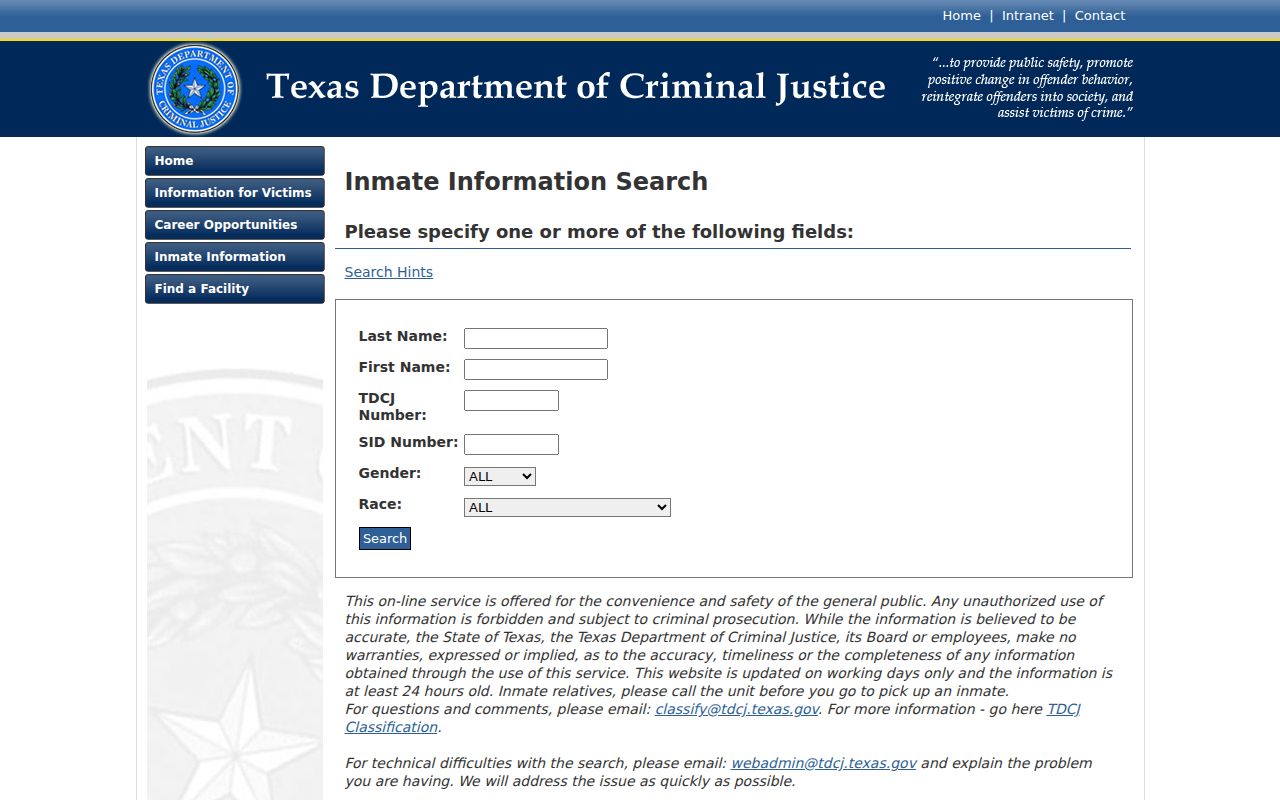
Use that state locator only after transfer or for TDCJ status. It does not contain every local booking. A dated state report gave the Kimble County Jail a 19-bed rating, but that figure is historical rather than a current headcount.
Probation and parole are also distinct. Adult Probation is temporarily at 105 Reid Road, while the TDCJ Parole Division and Texas Board of Pardons and Paroles handle state parole. A judgment may disclose the sentence, but officer notes, tests, treatment data, and residential details are not a general public database.
Kimble County Registry Record Search
The Texas Public Sex Offender Registry supplies name and geographic searches, with city, ZIP, county, address, radius, map, and list controls available by search mode. Select Kimble County for a county view. The Kimble County Sheriff serves as the local registration contact for county jurisdiction, but registration hours and fees were not located. Call before visiting.
The Texas Public Sex Offender Registry opens with the required warning and search controls.
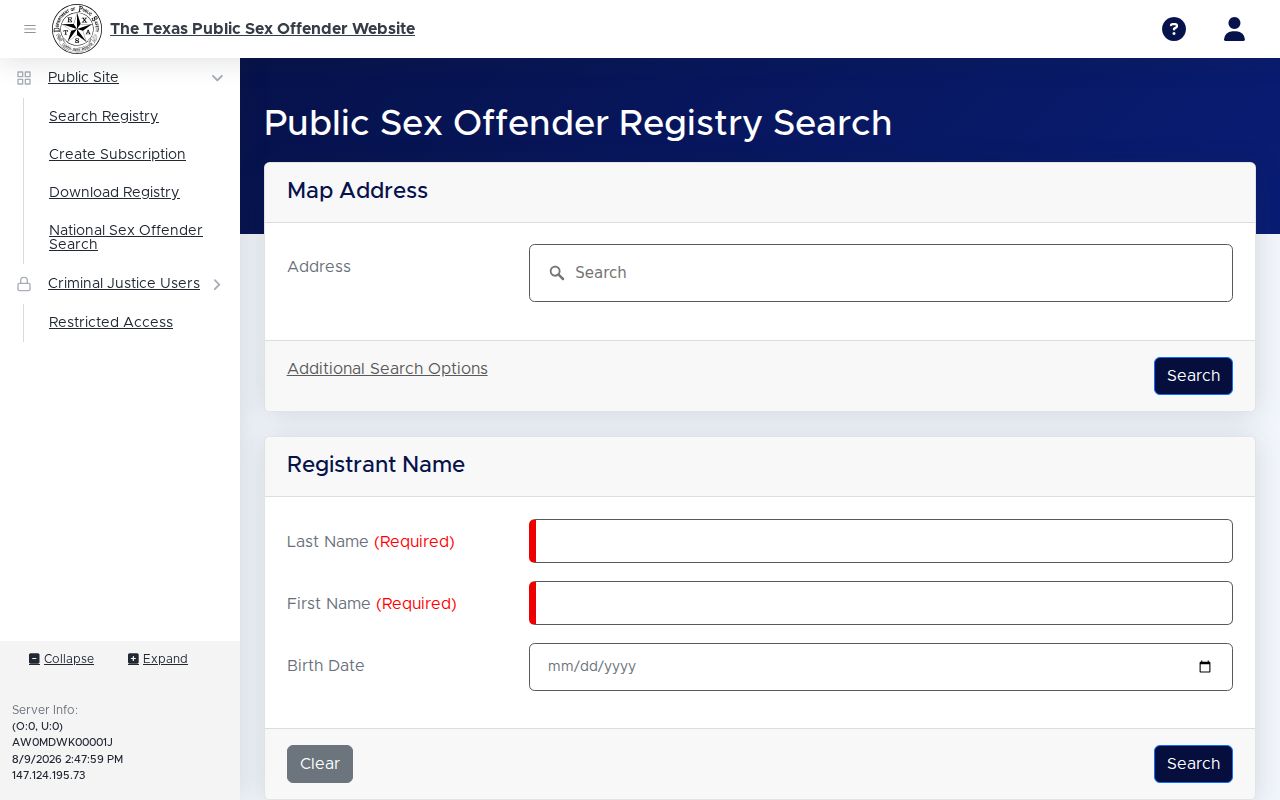
Registry results support safety awareness. They do not authorize threats, harassment, vigilantism, or misuse, and excluded fields such as victim identity and Social Security numbers remain nonpublic.
Texas registration duration is offense-based, not a simple federal tier chart. Some enumerated offenses require lifetime registration. Other qualifying adult offenses commonly require ten years after discharge, while juvenile and special cases follow separate provisions.
Criminal Records by City in Kimble County
Junction is Kimble County’s only incorporated city. Junction Police creates city incident and arrest reports, while Junction Municipal Court handles city ordinance and fine-only Class C matters. A person held after a city arrest goes to Kimble County Jail, and a filed Class A, Class B, or felony charge moves into county or district court. That split makes the agency name on a citation, report, or booking entry the best first routing clue.
Junction Criminal History
2024 estimate: 2,514 · Junction Police reports and Municipal Court records use city channels.